
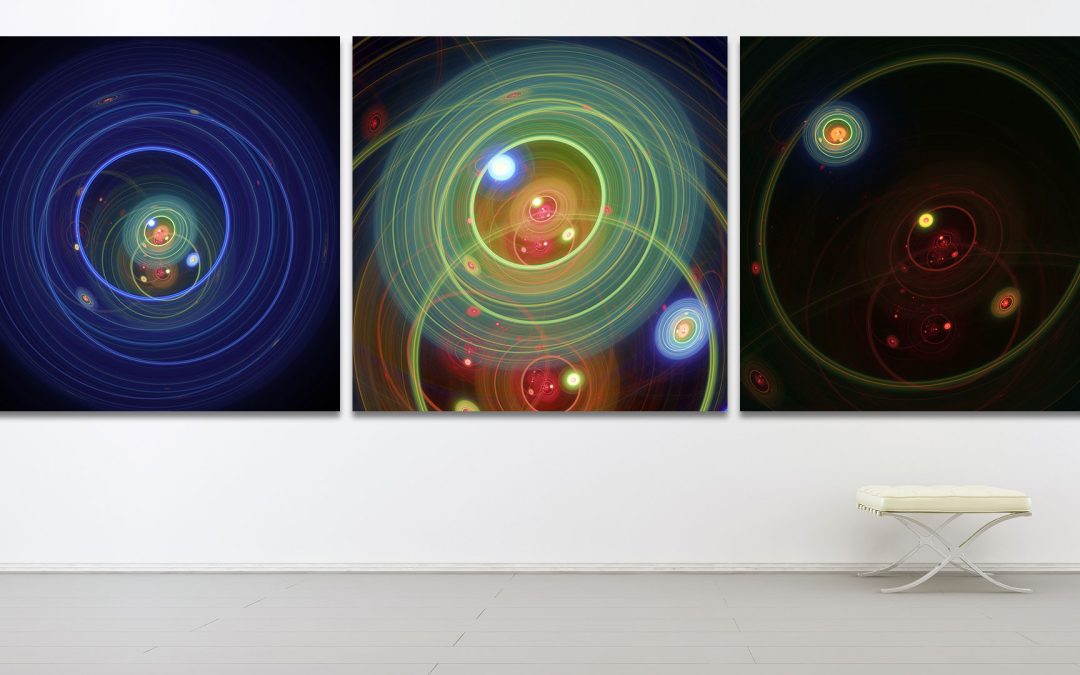
Defining Quality in Fractal Art Prints
What distinguishes mathematical fine art from a mere digital curiosity? In the world of fractal imagery, the line between a simple render and fine art is drawn by the artist's intentionality. High-end fractal art prints are not the result of random software clicks; they are the culmination of rigorous mathematical exploration and aesthetic discipline, in Bristow's case that comes from years as fulltime professional photographer and fine art photography printing. While a basic render might offer a surface-level visual, a fine art piece possesses a structural integrity that reflects a "Meticulous Visionary" approach. This philosophy, rooted in a practice that began in 1982 by Don Bristow, treats the mathematical formula not as a shortcut, but as a sophisticated tool for discovery. It's the difference between a fleeting digital trend and a work that commands long-term appreciation in a professional or private collection.
To evaluate quality, one must look closely at the edge definition and color depth. In complex patterns, inferior prints often suffer from "muddy" intersections where colors bleed or lines lose their crispness. A high-quality print maintains its precision even in the most intricate spirals. This level of detail is essential for pieces intended to serve as focal points in high-end residential or corporate spaces, where every element must stand up to close scrutiny. To maintain precision and detail, Bristow outsources his high-resolution printing to Vivid Metal Prints.
The Intersection of Logic and Aesthetics
When considering fractal art, one discovers a discipline where logic and beauty are inseparable. Mathematical formulas don't just generate shapes; they create visual narratives that mirror the complexity of the natural world. There is a profound difference between chaotic digital noise and structured fractal harmony. Intellectual spaces, such as executive offices or modern libraries, benefit from this structured aesthetic because it suggests a mind that values order and depth. Unlike AI-generated art that often lacks a consistent internal logic, these mathematically-derived works offer a sense of calm authority. Every iteration within the print is a deliberate choice, leading the viewer from a conceptual understanding to a deep physical appreciation of the work.
Resolution and Detail at Large Scales
Large-format wall art presents a unique set of technical challenges. For fractal art prints to maintain their impact, the source files must be of exceptionally high resolution. If the resolution is insufficient, the infinite complexity of the fractal is lost to pixelation, a flaw that becomes glaringly obvious at larger sizes. It's vital to distinguish between "intended complexity," where the mathematical patterns continue to reveal detail upon closer inspection, and the technical failure of an upscaled image. This is why custom sizes and multi-panel installations require such a meticulous eye. Whether the art is displayed on a single white aluminum panel or across a series of custom-framed sections, the integrity of the mathematical pattern must remain sharp and unwavering to ensure a professional, high-end. Fractal artworks by Don Bristow are typically resolved at 50 inches by 50 inches at 300 ppi per panel, or 225M pixels.